
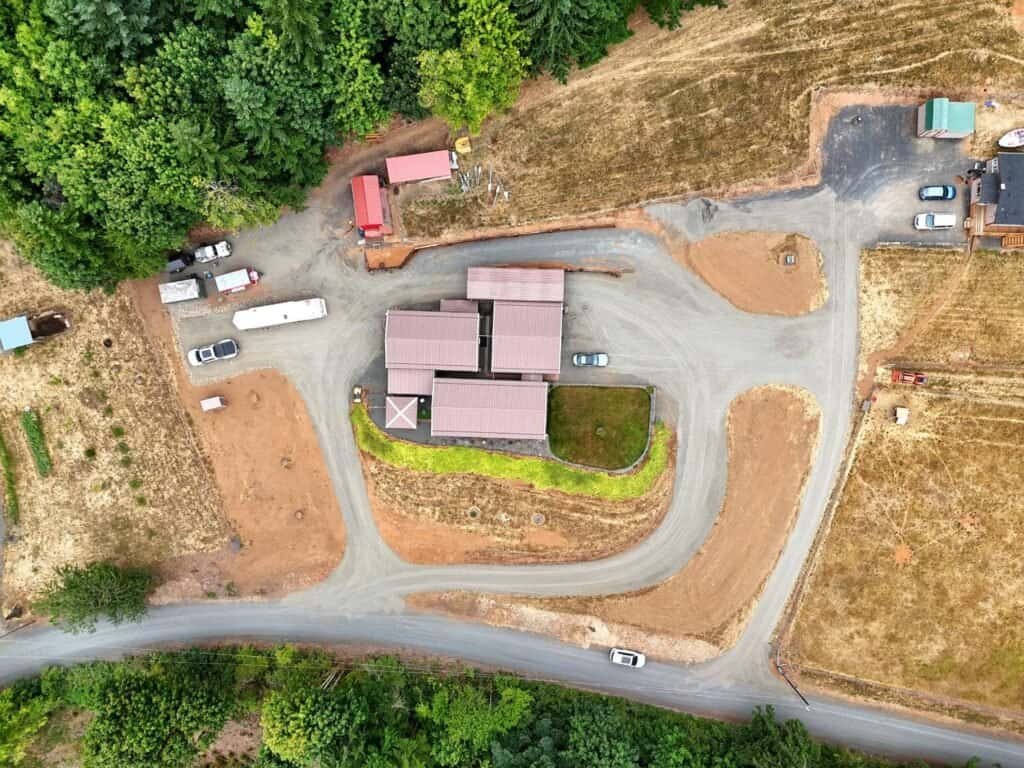
If you’re building a new home, putting up a shop, or finally adding a proper route across a rural property, the driveway is usually one of the first things that needs to happen.
From the road, a gravel driveway can look pretty simple: a strip of rock from point A to point B. But the difference between a driveway that holds up for years and one that ruts out after the first wet season comes down to everything you can’t see once it’s finished.
At M4 Landworks, we build new gravel driveways in layers, and we plan them in three parts: choosing the right route, building a solid foundation, and planning for water. Get those three right, and the driveway does its job for a long time.
Here’s how we approach each one.
1. Planning the Route: Where Your New Driveway Should Go
Why it matters
Every new driveway. The route comes first, and it affects nearly every decision that follows, from how much base rock you’ll need to how the driveway handles rain.
A lot of driveway problems start with a route that fights the property instead of working with it. Low spots collect water, steep pitches wash out, and tight corners make life hard for anyone pulling a trailer.
What Makes a Good Driveway Route?
When we walk a property to plan a new driveway, here’s what we’re looking at:
- High ground where possible: Following the higher ground lets water drain away from the driveway instead of running across it.
- Avoiding low, wet areas: Wet ground needs extra base rock and drainage work, so we route around it when we can.
- Manageable grades: Steep sections are harder to keep from washing out and need extra attention to drainage.
- Room for the vehicles that will use it: Delivery trucks, RVs, trailers, and equipment all need enough width and turning space.
- What’s underground: Existing utilities, and where future utilities may need to run, are part of the plan.
A few minutes spent on the route up front can save a lot of money and frustration later.
2. Building the Foundation: What Goes Under a Gravel Driveway
Why it matters
The part of the driveway you’ll never see again once it’s done, and the part that decides how long it lasts.
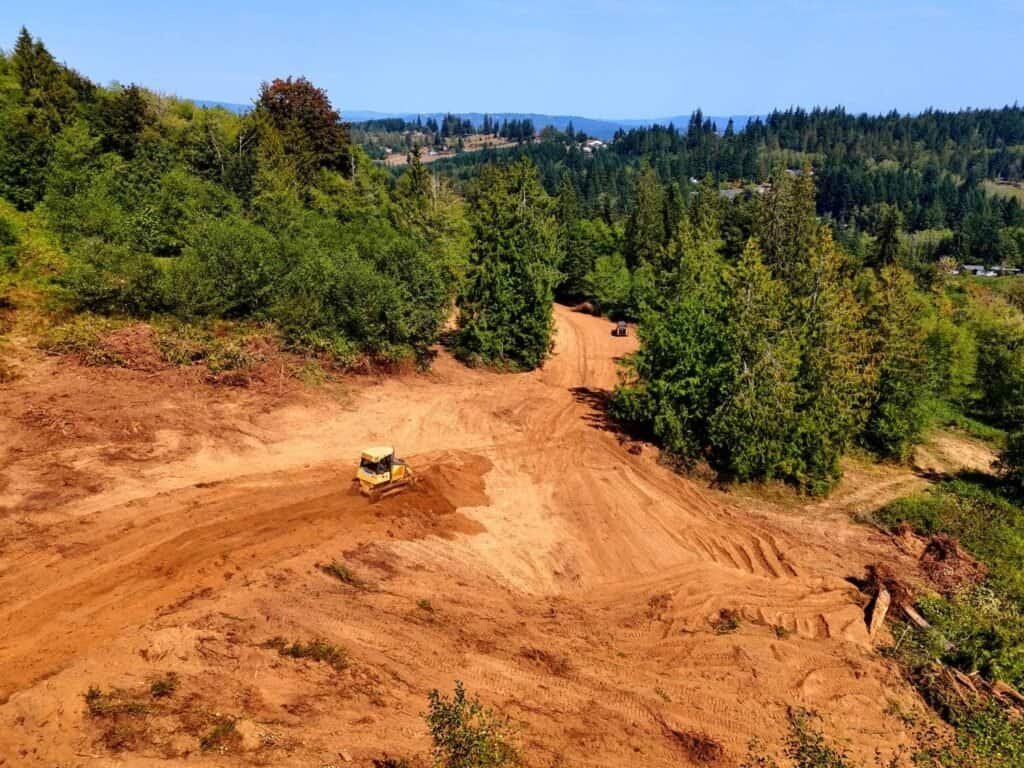
A gravel driveway is only as good as what’s underneath it. Spreading rock over grass or topsoil might look fine for a few weeks, but it won’t hold up to regular traffic and Northwest Oregon rain.
Clearing and Stripping
The first step is removing vegetation and topsoil along the route. Topsoil is soft and full of organic material, so any rock placed on top of it will eventually sink and rut.
Stripping down to firm subgrade gives the driveway a solid starting point.
Structural Base Rock
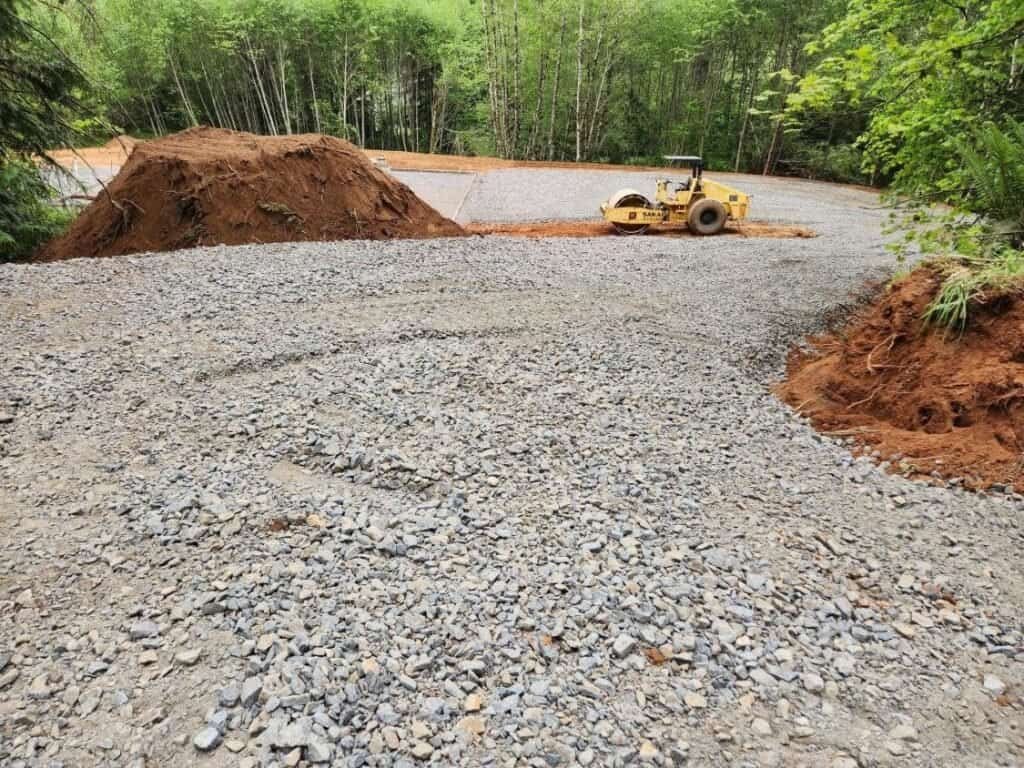
Once the subgrade is shaped and compacted, we place a layer of larger crushed base rock. This is the layer that carries the weight of vehicles and spreads it out over the ground below.
On soft or wet ground, we install road fabric under the base. The fabric keeps the rock from mixing into the soil over time, which helps the driveway stay firm instead of slowly sinking.
Finish Gravel and Compaction
The top layer is crushed rock with fines, typically 3/4-inch minus. It’s graded to shape and then roller-compacted.
The fines fill the gaps between the larger stones, so the surface locks together into a firm, smooth driving surface. That’s also why crushed rock works so much better than round rock for driveways. Our guide to 3/4-inch minus vs. 1-1/2-inch minus vs. pea gravel goes into more detail.
3. Planning for Water: How a New Driveway Handles Drainage
Why it matters
Every driveway in Northwest Oregon, where most of the year’s rain falls between fall and spring.
Water is the biggest enemy of a gravel driveway. When it sits on the surface or runs down the middle, it softens the base, carries away the fines, and leaves potholes and ruts behind.
That’s why we plan drainage in from the start rather than trying to add it later.
How Do We Keep Water Off the Driveway?
- Crown or slope: The finished surface is crowned, slightly higher in the middle than at the edges, or sloped to one side so rain runs off instead of collecting.
- Ditches: Ditches along the edges catch that runoff and carry it away from the driveway.
- Culverts: Where water needs to cross under the driveway, a culvert lets it pass without washing out the surface. Our post on what a driveway culvert does explains why they matter.
A driveway that sheds water properly is a driveway that stays smooth longer and needs a lot less maintenance.
Long, Steep, or Hillside Driveways: What Changes?
Longer driveways and access roads simply need more of everything: more clearing, more grading, more base rock, and more finish gravel.
Steep sections need extra care to keep water from running straight down the surface. Hillside driveways may need more excavation to set a workable grade, additional drainage, and more base rock in areas where the ground is soft. On some sites, widened curves or turnarounds are part of the plan too.
These are the main reasons longer and more challenging driveways cost more than a short, flat approach.
How Much Does a New Gravel Driveway Cost?
The cost of a new gravel driveway depends mostly on its length, the terrain, and the ground conditions along the route. Here’s what typical M4 Landworks projects look like:
Short residential driveways, shop approaches, and smaller access roads built from the ground up.
New gravel driveways serving homes, shops, barns, and other residential or rural properties.
Longer routes or challenging sites with steep terrain, elevation changes, or substantial excavation.
Within each of those, the biggest factors are:
- Length and width of the driveway.
- Terrain and slope along the route.
- Ground conditions, including soft or wet areas that need more base rock or road fabric.
- Clearing of trees, brush, or stumps along the route.
- Drainage needs, such as ditches and culverts.
- Access for equipment and trucks.
These ranges represent typical projects, not fixed prices. Every route is different, so the final price comes from a property walkthrough and a written quote. You can see more on our typical project pricing page.
Frequently Asked Questions
Most new driveways are built with a compacted layer of crushed base rock under a top layer of crushed finish gravel. Soft or wet ground may need a thicker base and road fabric. The right depth depends on the soil and the vehicles that will use the driveway.
Road fabric is most useful on soft, wet, or clay soils. It separates the base rock from the soil underneath so the rock doesn’t sink into the ground over time. On firm, well-drained ground, it often isn’t needed.
Crushed rock with fines, such as 3/4-inch minus, is the most common choice. The angular stones and fines pack together into a firm surface. Round rock and pea gravel roll under tires and don’t lock together.
Work is possible in some conditions, but it’s harder to grade and compact a driveway properly when the ground is saturated. Late spring through early fall is usually the best time to build.
Free estimates
Ready to Plan Your New Driveway?
Whether you need a short approach to a new shop or a long access road across a rural property, the best place to start is a walk down the route you have in mind.
At M4 Landworks, we build new gravel driveways throughout Columbia County, portions of Washington County, and Northwest Portland.
Take a look at our gravel driveway services and site preparation pages, or request a free estimate. We’ll walk the property with you, talk through the route and the options, and put together a plan that makes sense for your site.