
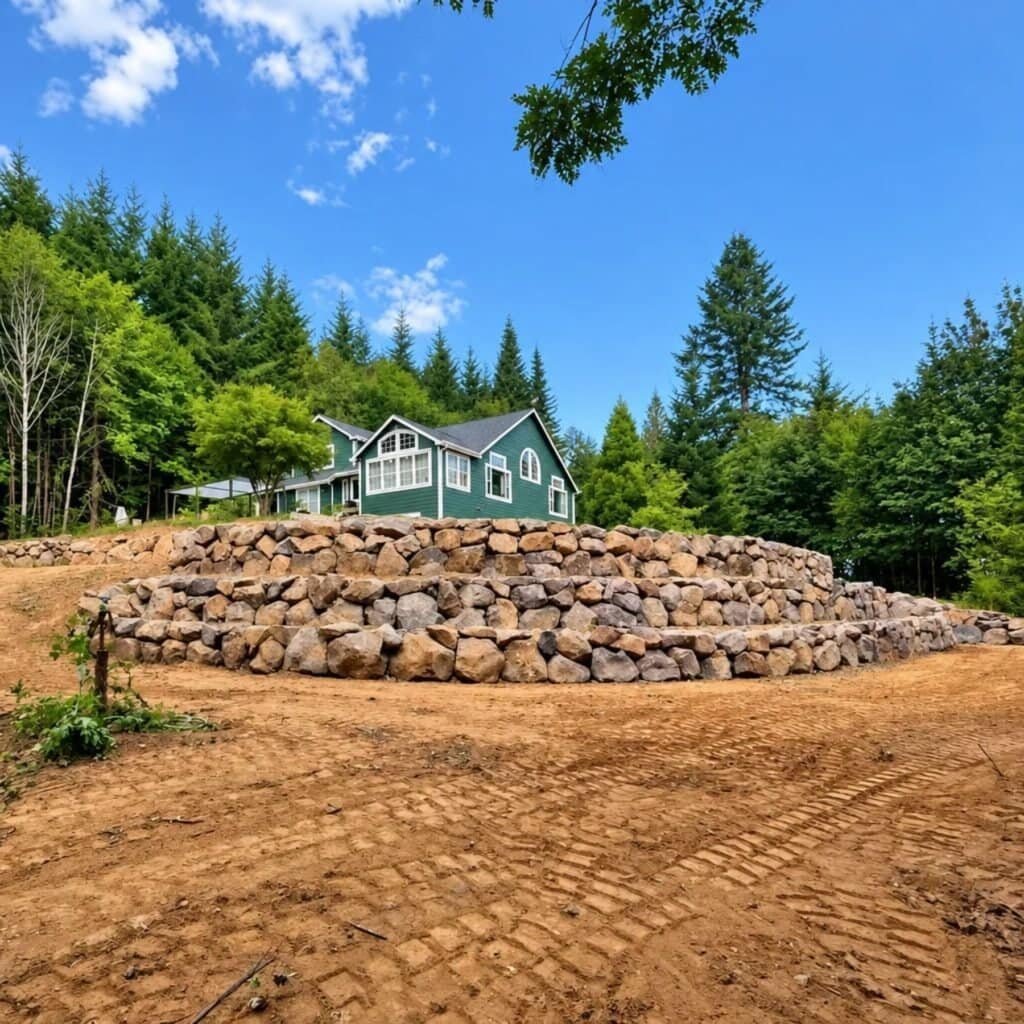
A steep slope can make part of your property hard to use. Maybe it’s a hillside yard you can’t mow, a bank beside the driveway that keeps sliding, or a cut behind a new building site that needs to be held back.
A retaining wall solves that by holding the slope in place and creating flatter, more usable ground. And on rural and wooded properties, few options look as good or hold up as well as a natural boulder wall.
At M4 Landworks, we build boulder retaining walls in three main stages: excavating a stable foundation, setting the boulders, and installing drainage behind the wall. Each one matters, but as you’ll see, the parts you don’t see are what make a wall last.
When Does a Boulder Retaining Wall Make Sense?
Best for
Sloped properties where you want more usable, level ground, a bank that needs to be held back, or a natural look that blends into the landscape.
A boulder wall is a great fit when you want to:
- Create level space for a yard, parking area, garden, or building site on a sloped property.
- Hold back a bank along a driveway or access road.
- Manage erosion on a slope where soil keeps washing down.
- Add a natural look that blends into rural and wooded properties better than concrete or block.
Worth knowing
Very tall walls, walls that support a building or driveway load right at the top, or walls in unusual soil conditions may need engineering or a different type of wall. Large interlocking block retaining walls may also be an option, depending on the project.

How Do We Build a Natural Boulder Retaining Wall?
A boulder wall might look like a row of big rocks stacked against a hill, but there’s a lot more to it than that. Here’s what goes into building one that stays put.
Step 1: Excavation and a Stable Foundation
First, we excavate the area and prepare the base of the wall on firm ground.
The bottom row of boulders carries the weight of everything above it, so a stable foundation is the single most important part of the wall. If the base shifts or settles, the whole wall follows.
Step 2: Setting the Boulders
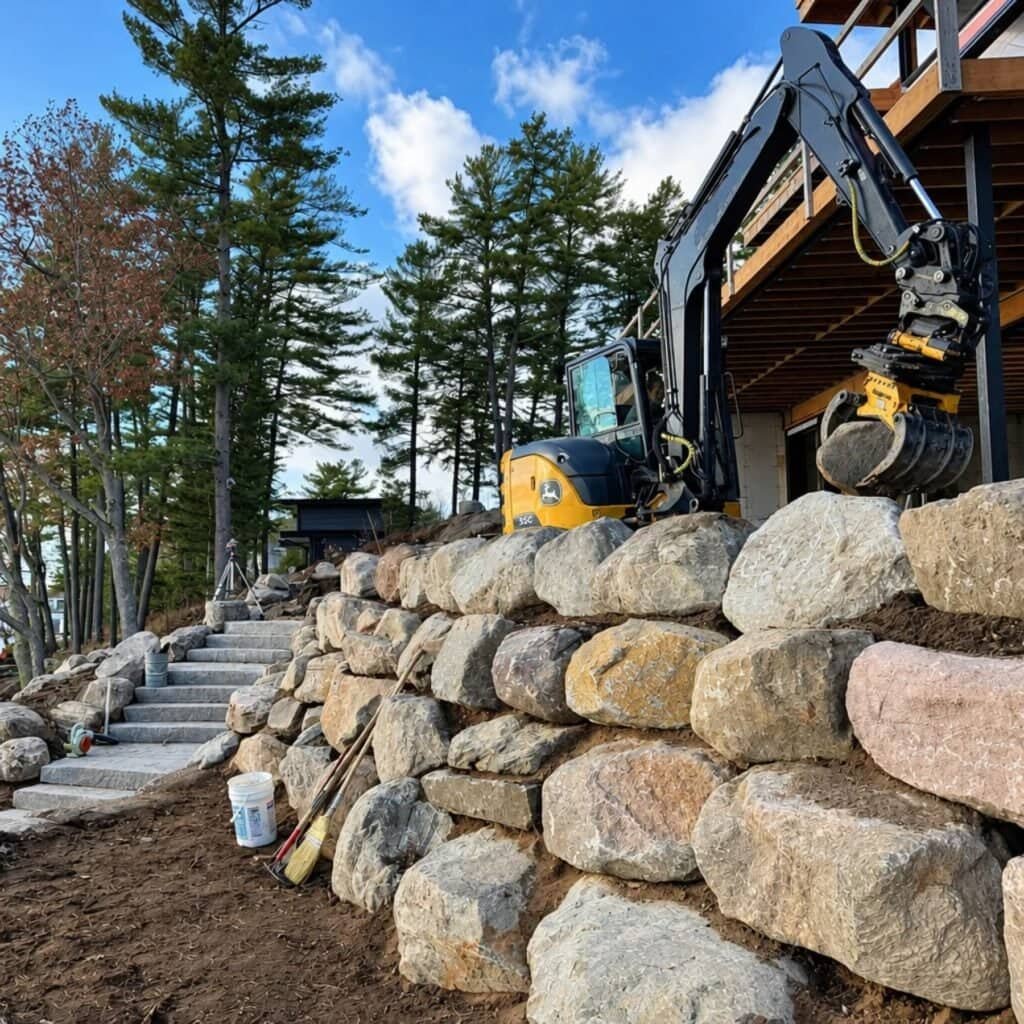
Next, quarry boulders are set with an excavator, one at a time.
Each boulder is positioned so it rests securely on the ones below it, and the wall usually leans slightly back into the slope. That careful placement is what makes a boulder wall look natural, and it’s what keeps each stone locked in place for the long haul.
Step 3: Drainage and Backfill
Finally, we install clean drain rock and a drain pipe behind the boulders, then backfill the area behind the wall.
The part most walls get wrong
Why Drainage Matters Most
Water is the main enemy of any retaining wall, especially through a long Northwest Oregon wet season.
When the soil behind a wall gets saturated, it pushes on the wall with much more force than dry soil does. Drain rock and a drain pipe give that water a way out, so pressure doesn’t build up behind the boulders.
Most retaining wall problems come from poor drainage or a weak base, not from the boulders themselves. That’s why we never skip this step.
Boulder Wall vs. Block Wall: Which Is Right for You?
Both can hold back a slope. The right choice depends on your site, the look you want, and how the space will be used.
A rugged, natural look that suits rural properties, wooded lots, and landscaped slopes. Each wall is a little different, and it blends right into the surrounding landscape.
Large interlocking blocks give a cleaner, more uniform face. They can make sense where space is tight or a straighter, more finished look is needed.
Neither one is better in every case. When we look at your site, we’ll talk through which option makes the most sense for what you’re trying to accomplish.
How Much Does a Boulder Retaining Wall Cost?
Boulder retaining wall costs depend mostly on the size of the wall and what it takes to build it on your site. Here’s what typical M4 Landworks projects look like:
Smaller quarry-boulder walls for landscaping, raised areas, and modest slopes.
Taller or longer boulder walls that hold back steeper banks and create larger level areas.
The biggest factors that affect the price are:
- Wall size, including length and height. This is the biggest factor, and it’s what separates a small wall from a large one.
- Terrain and access for the excavator and trucks.
- Excavation: how much cutting into the slope is needed.
- Boulders: the type and quantity required.
- Drainage requirements behind the wall.
The pricing above represents typical M4 Landworks projects, not fixed prices. Every slope is different, so the final price comes from a property walkthrough and a written quote. You can explore our typical project pricing to compare it with other projects.
Frequently Asked Questions
A properly built boulder wall with a stable foundation and good drainage behind it can last for decades. Most wall problems come from poor drainage or a weak base, not from the boulders themselves.
Yes. Drain rock and a drain pipe behind the wall let water escape instead of building up pressure behind the boulders. Saturated soil pushes much harder on a wall than dry soil.
Yes, boulder walls are often used to hold back steep banks and create level space. Very tall walls or walls that support heavy loads may need engineering or a different wall type.
Neither is better in every case. Boulder walls have a natural look that suits rural and wooded properties. Block walls give a cleaner, uniform face and can work better where space is tight.
Free estimates
Have a Slope That Could Be More Useful?
Whether it’s a hillside yard, a bank along the driveway, or a cut behind a new building site, the best place to start is taking a look at the slope and what you’d like to do with the space.
At M4 Landworks, we build natural boulder retaining walls throughout Columbia County, portions of Washington County, and Northwest Portland.
Take a look at our excavation and land services or request a free estimate. We’ll look at your site, talk through your options, and help you decide on the wall that makes the most sense for your property.