
A soggy yard, a puddle that never seems to dry up or water creeping toward the house after every storm are some of the most common problems on properties in Northwest Oregon. The three most common fixes are French drains, swales and dry creek beds. They all move water, but they work in different ways, and the right choice depends on where your water is coming from and where it is able to go.
Start here: where is the water coming from?
Before choosing a fix, watch your property during and after a heavy rain. Two very different problems can look similar the next day:
- Surface water is runoff you can see moving across the ground, from a slope, a roof, a driveway or a neighboring property. It sheets across the lawn and collects in low spots.
- Subsurface water is water already in the ground. The surface may look dry, but the soil stays soggy and spongy for days, or water seeps up in the same spot over and over.
Surface water is usually best handled on the surface. Subsurface water usually needs a drain below ground. Many properties have some of both.
What is a French drain?
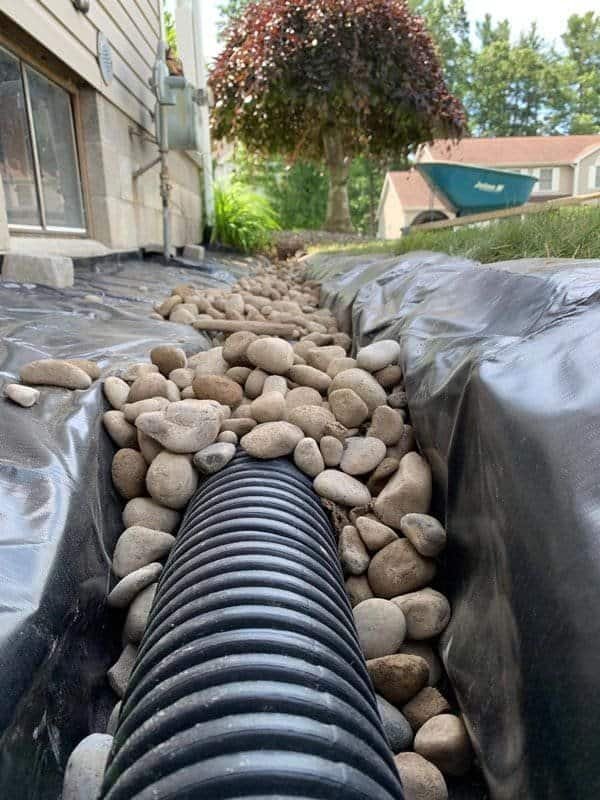
A French drain is a trench dug along a gentle downhill slope, lined with filter fabric, partly filled with clean drain rock, fitted with a perforated pipe, and then covered with more rock. Water in the surrounding soil seeps into the trench, enters the pipe through its holes and flows downhill to an outlet.
- Best for: soggy ground that stays wet, water near a foundation, wet crawlspaces and areas where the soil holds water.
- Strengths: it works below the surface, so the yard above can still be lawn or landscaping.
- Keys to doing it right: a steady slope from start to finish, filter fabric to keep soil from clogging the rock, clean drain rock and a safe place for the water to come out.
The most common reason French drains fail is that they have nowhere to send the water. A drain that ends in a flat spot simply moves the puddle a few feet.
What is a drainage swale?

A swale is a shallow, gently sloped channel shaped into the ground to collect surface runoff and guide it somewhere it can drain safely. Think of it as a very wide, very shallow ditch that blends into the landscape. Swales can be lined with grass or with rock.
- Best for: water sheeting across a yard from a slope or roof, runoff from a driveway, and directing water around a building.
- Strengths: simple, low maintenance and able to move a lot of water during heavy storms.
- Keys to doing it right: a consistent grade so water keeps moving, and an outlet that does not just push the problem onto a neighbor or the road.
What is a dry creek bed?

A dry creek bed is a swale lined with rock and often accented with larger boulders, built to look like a natural streambed. It carries water during storms and stays dry the rest of the time. Some dry creek beds also have a French drain hidden underneath for added capacity.
- Best for: the same surface water problems as a swale, especially in visible areas where looks matter.
- Strengths: it handles runoff and doubles as a landscape feature. Rock also resists erosion better than bare soil in fast-moving water.
- Keys to doing it right: rock sized for the flow, fabric underneath to limit weeds and erosion, and the same steady grade and safe outlet as any swale.
Side-by-side comparison
| French drain | Swale | Dry creek bed | |
|---|---|---|---|
| Handles | Water in the soil | Surface runoff | Surface runoff |
| Location | Below ground | On the surface | On the surface |
| Look | Hidden | Grass or rock channel | Natural streambed |
| Maintenance | Low if built right | Low | Low, occasional weeding |
| Common pairing | Under a dry creek bed | With a culvert under a driveway | With a French drain below |
How do you know which one you need?
- Ground stays soggy for days but you do not see water flowing: a French drain is usually the answer.
- Water visibly runs across the yard during storms: a swale or dry creek bed is usually simpler and more effective.
- Water pools against the foundation: often a mix of regrading the soil away from the house, extending downspouts and adding a French drain.
- Water crosses a driveway: a swale or ditch along the driveway with a culvert underneath.
Sometimes the best fix is not a drain at all. Reshaping the yard so it slopes away from buildings, or simply extending downspouts farther from the house, can solve a surprising number of problems.
Where can the water legally go?
Every drainage plan needs an outlet: a ditch, a lower part of your property, a dry well or another suitable spot. Avoid directing concentrated water onto a neighbor’s property or into the road. If you are not sure what is allowed where you live, your county or city can tell you.
What affects the cost of a drainage project?
- Length of the drain or swale.
- Depth needed to reach the problem water or maintain slope.
- Access for equipment, and whether the work is close to buildings, fences or landscaping.
- Materials, such as how much drain rock, pipe and fabric are needed.
- Restoration of lawn or landscaping afterward.
Frequently asked questions
Yes. A French drain underneath handles water in the soil, while the rock-lined creek bed on top handles surface runoff during storms. It is a common combination where both kinds of water are a problem.
It depends on the problem. Drains for soggy lawns are often fairly shallow, while drains protecting a foundation may need to be deeper. What matters most is a steady slope along the full length and a proper outlet.
Not always. Grass-lined swales work well where water moves slowly. Rock is better where water moves fast, on steeper slopes or in spots where grass will not grow.
The most common causes are no proper outlet, a run that is not sloped consistently, soil clogging the rock because filter fabric was not used, or a drain installed where the problem is actually surface runoff.
If you are curious how we approach these projects, our drainage solutions page walks through French drains, swales and culverts in more detail. For the right rock, see our guide to gravel types.